
Home Salon vs Salon Studio: Which Is More Profitable in 2026
QuarkBooker Team

A home salon offers lower overhead and faster break-even, while a salon studio (suite) delivers higher earning potential, stronger brand positioning, and greater scalability. Which is more profitable depends entirely on your stage of business, client volume, and long-term goals.
Introduction
The debate between home salon vs salon studio is one of the most practical decisions a beauty professional faces in 2026. With the U.S. salon industry valued at approximately $60 billion and the independent salon suite market growing at over 10% annually, both models are thriving — but they serve very different business strategies. This article breaks down the real cost, profit potential, and trade-offs of each model so you can make a financially sound decision.
Understanding the Two Models
Before comparing profitability, it's important to define what each model actually means in practice.
Home Salon A home salon operates out of a dedicated space within your private residence — a converted spare room, basement, or garage. It's licensed, compliant with local zoning laws, and fully operational as a business.
Salon Studio (Suite) A salon suite is a private, self-contained space rented inside a larger studio complex (such as Sola, Suite Elite, or independent suites). You operate as a fully independent business owner within a professional commercial environment.
Home Salon vs Salon Studio: Cost Comparison
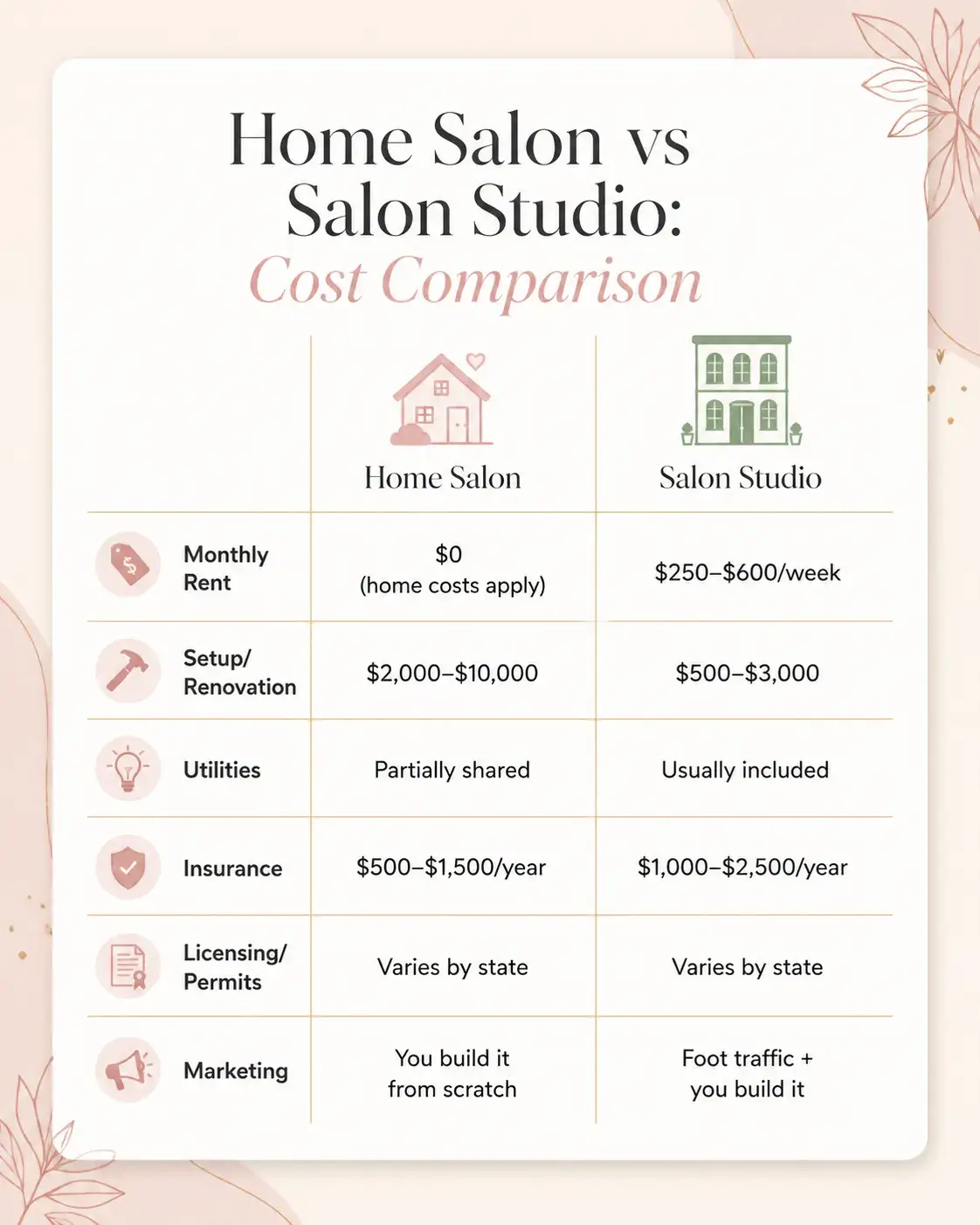
A home salon's biggest financial advantage is the elimination of commercial rent, which is typically the largest overhead expense for any salon business. However, it comes with hidden costs: home zoning permits, separate business insurance riders, and potential HOT (Home Occupation Tax) depending on your jurisdiction.
Independent salon professionals in studio suites can increase their take-home pay by as much as 40% compared to working under traditional commission structures — but this comparison is against employed positions, not home salons.
Profitability Breakdown: Home Salon
Advantages
- Zero commercial rent: The most significant cost saving. Eliminating $1,000–$2,500/month in rent directly improves your net margin.
- Lower break-even point: With minimal fixed costs, a home salon operator can become profitable much faster.
- Tax deductions: A dedicated home salon space qualifies for the IRS home office deduction, covering a proportional share of mortgage/rent, utilities, and internet.
- Flexible hours: No shared-space rules or building access restrictions.
Limitations
- Client perception: Some clients hesitate to visit a home address, especially for first bookings.
- Zoning restrictions: Many residential zones restrict or prohibit commercial activity. Violations can result in fines or forced closure.
- Scalability ceiling: You can only accommodate one client at a time, and expanding means moving.
- Work-life separation: Boundaries between personal and professional life erode quickly.
- Limited retail opportunity: Without a polished retail display, product sales — which can carry margins of 40–50% — are difficult to leverage.
Realistic Earnings
A solo home salon operator with 15–20 clients per week at an average ticket of $75–$120 can realistically generate $60,000–$100,000 in gross revenue annually. After home business expenses, net income typically falls between $45,000–$75,000, depending on service mix and local market pricing.
Profitability Breakdown: Salon Studio
Advantages
- Professional environment: A studio space signals credibility and commands premium pricing. Clients consistently pay more for a private, polished experience.
- Privacy drives retention: Research shows that 95% of clients report feeling "safer" or "more private" in a salon suite than in a traditional open-floor salon, which directly supports loyalty and repeat bookings.
- Retail revenue: A dedicated, well-merchandised studio creates real opportunities to grow retail sales. Retail product sales account for 10%–15% of a typical suite owner's total revenue.
- No staff overhead: As a solo suite operator, you keep 100% of your service revenue after rent.
- Longer appointments = higher tickets: Appointment times in suites average 10 minutes longer than in traditional salons, allowing for more add-on services and a higher average ticket.
Limitations
- Fixed weekly rent: Rental rates of $250–$600 per week create a significant fixed cost that must be covered regardless of bookings.
- Slower initial break-even: You need a strong existing client base before moving into a suite. Without it, the rent can erode profits quickly.
- Solo operation limits: Like a home salon, you can only work with one client at a time without hiring an assistant.
Realistic Earnings
A productive suite operator with 20–28 clients per week at an average ticket of $100–$150 can generate $100,000–$175,000 in gross revenue annually. After suite rental fees, supplies, and business expenses, net income typically ranges from $55,000–$95,000+, with experienced operators in high-demand markets earning well above that.
For a deeper look at how to optimize your pricing and service mix to maximize take-home pay, see How to Operate a Salon Business (2026 Profit Guide).
H2: Home Salon vs Salon Studio — Which Wins on Profit Margin?
The average salon operates with a net profit margin of 8–15%, with gross margins on services typically running 50–65%. Both models can exceed this benchmark — but through different mechanisms.
Metric Home Salon Salon Studio Gross Revenue Potential Lower (limited capacity) Higher (premium pricing) Net Profit Margin Higher % (low overhead) Moderate % (rent cost) Total Dollar Profit Lower absolute number Higher absolute number Scalability Very limited Moderate (add staff/hours) Brand Value Difficult to build Strong and professional The key insight: A home salon often wins on margin percentage because fixed costs are minimal. A salon studio often wins on total profit dollars because higher ticket prices and stronger client retention drive greater gross revenue. If your goal is maximum take-home income, a well-run studio consistently outperforms a home salon at full capacity.
Key Factors That Decide Which Model Is Right for You
Choose a home salon if:
- You are just starting out and need to build a client base with minimal financial risk
- You have fewer than 10–12 regular weekly clients
- Local zoning permits it and you have a dedicated, private space
- Your goal is supplemental income or a part-time practice
Choose a salon studio if:
- You have an established client book of 15+ weekly clients
- You want to position yourself in a premium market and charge accordingly
- You are serious about retail revenue as part of your income strategy
- You want a clear separation between work and home life
To understand how top-performing salons manage their product revenue alongside services, read Salon Retail Profit Margins: Products & Strategies That Work.
The Role of Technology in Both Models
Whether you operate from home or a studio, your booking and management systems directly impact your profitability. Clients whose first visit was booked online are approximately 2x more likely to return than walk-ins, and roughly 46–50% of all bookings happen when salons are closed — meaning 24/7 online booking is not optional, it's essential.
No-show rates are another major profit killer. A 10% no-show rate on an $85 average ticket can cost a salon $30,000–$60,000 per year. Automated reminders and deposit requirements can cut no-shows by 50–70%.
For a full breakdown of the technology features that support both models, see Top 10 Features to Look for in a Salon Management System.
Thinking About Growth Beyond the Chair?
If you're planning to grow your personal brand alongside your salon business, the platform you choose matters. Whether you're building an Instagram presence or positioning yourself as a local authority, your digital strategy should run parallel to your operational model. Top Salon Trends in 2025 Every Salon Owner Should Follow covers the market shifts shaping how clients discover and choose their stylist in 2026.
FAQ: Home Salon vs Salon Studio
Q: Is a home salon legal? A home salon is legal in many areas, but it requires a valid cosmetology license, local business permit, and compliance with residential zoning laws. Requirements vary significantly by city and state. Always verify with your local licensing board before operating commercially from a residence.
Q: How much does it cost to rent a salon suite? Salon suite rental rates typically range from $250 to $600 per week depending on location, suite size, and included amenities. High-demand urban markets skew toward the upper end, while suburban or mid-size markets often offer more competitive rates.
Q: Can you make 6 figures from a home salon? Yes, but it is uncommon. Reaching six-figure gross revenue from a home salon requires a full appointment book, premium pricing, consistent retail sales, and a highly efficient schedule. Most home salon operators earn between $45,000 and $75,000 net annually.
Q: What is the average profit margin for a salon suite owner? A salon suite owner who manages costs effectively can achieve net profit margins of 15–25%, outperforming the industry average of 8–15%. The key variables are weekly rent cost relative to average ticket price and client volume.
Q: Which is easier to scale — a home salon or a studio suite? A salon studio is significantly easier to scale. Options include extending hours, hiring an assistant, adding a second suite, or transitioning to a larger commercial space. A home salon has hard physical and legal limits on growth.
Conclusion
Both the home salon and the salon studio are legitimate, profitable business models in 2026. The right choice depends on where you are in your business journey — not which model looks better on paper.
If you are building from scratch with limited capital, start with a home salon to grow your book without financial pressure. When your client list is full and you are consistently turning people away, a salon suite becomes the logical next step — and the one most likely to significantly increase your total take-home income.
Regardless of which model you choose, one truth applies to both: operational efficiency drives profitability. Many successful salon owners — in home settings and studio suites alike — use dedicated booking and management platforms to automate appointment scheduling, reduce no-shows with automated reminders, and track key revenue metrics without manual effort. If you are ready to streamline your operations, QuarkBooker offers salon management tools built for independent professionals at any stage of growth.
Sources:
- IBISWorld – Hair Salons in the US (2026)
- Vagaro – Hair Salon Profit Margins: 2026 Benchmarks
- Boulevard – Salon Industry Trends & Statistics (2025)
- WifiTalents – Salon Suites Industry Data Report (2026)