How AI Can Fill Empty Salon Appointments Automatically
QuarkBooker Team
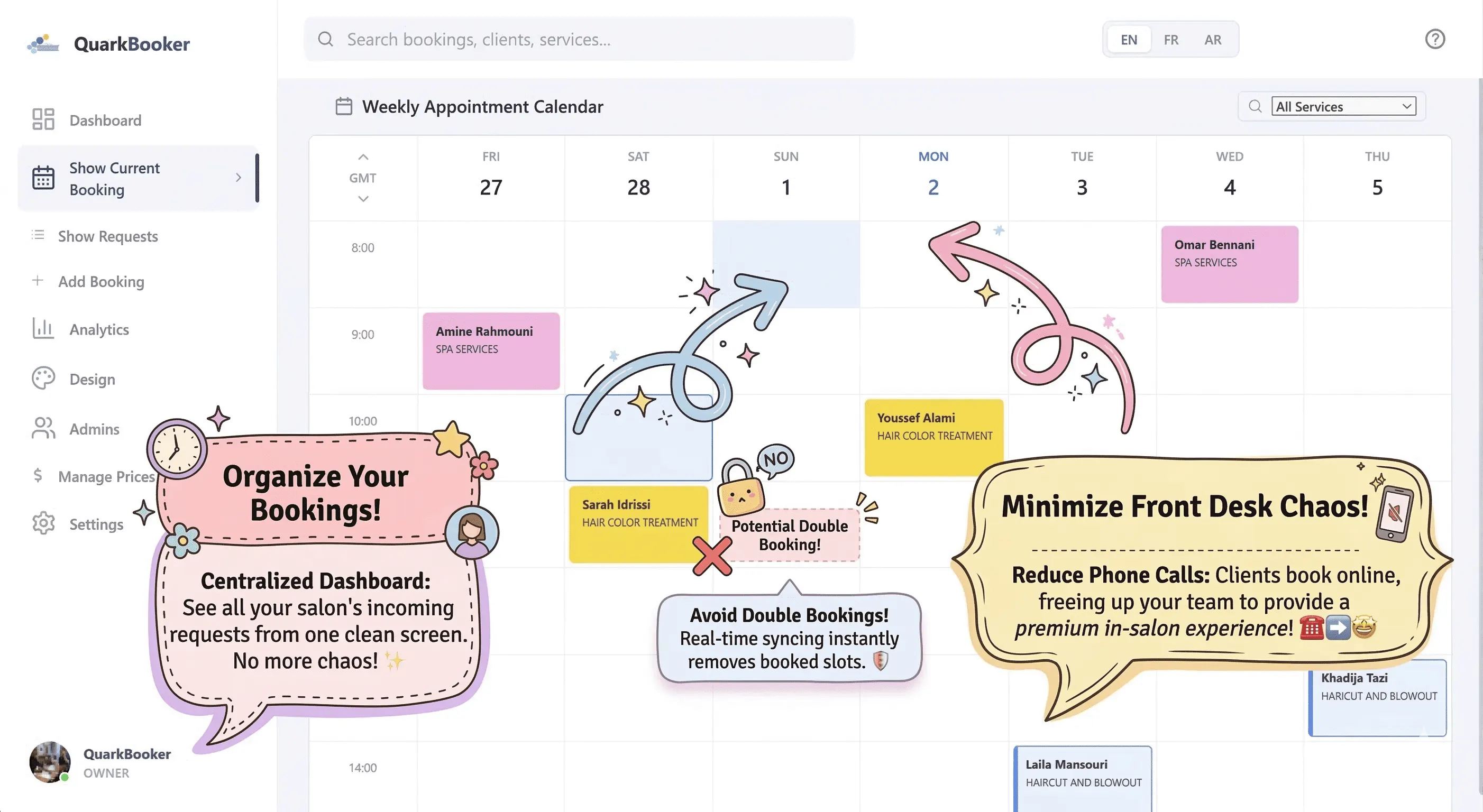
As a salon owner or manager, there are few things more frustrating than looking at your fully booked daily schedule, only to receive a last-minute cancellation text. Suddenly, your most profitable stylist has a two-hour gap, an empty chair, and lost revenue. Even worse are the no-shows—clients who simply forget their appointments, leaving you entirely in the lurch without enough time to manually scramble and find a replacement.
For years, the industry accepted this as the standard cost of doing business. Front desk staff would frantically call clients on a handwritten waitlist, hoping someone could rush over in thirty minutes. It was stressful, inefficient, and often unsuccessful.
Today, artificial intelligence is completely changing the game. AI is no longer just a futuristic concept for massive tech corporations; it is an accessible, practical tool that beauty businesses use every day. By understanding how AI can fill empty salon appointments automatically, you can protect your bottom line, reduce front desk burnout, and ensure your chairs stay full.
The True Cost of Empty Salon Chairs
Before diving into the technology, it is important to understand the financial drain of empty appointments. Every minute a chair sits empty during operating hours is money left on the table.
Let’s look at a practical example. Imagine your salon’s average service ticket is $100. If you have just three no-shows or unfilled last-minute cancellations a week, that is $300 of lost revenue. Over a 52-week year, that equates to $15,600 walking out the door. If you manage a team of five stylists dealing with the same issue, your salon could be losing over $75,000 annually.
According to resources like Salon Today, minimizing no-shows and maximizing schedule efficiency are two of the most critical factors in maintaining a profitable beauty business. Relying on human effort alone to plug these gaps is no longer viable. Human staff get busy, distracted, and simply cannot process data fast enough to fill a spot the second it opens up. AI, however, works instantly and tirelessly in the background.
How AI Turns Cancellations into Opportunities
So, how exactly does this technology work in a real-world salon environment? AI doesn’t just guess; it uses intelligent algorithms to match open time slots with the clients most likely to book them.
Smart Automated Waitlists
The traditional waitlist is a passive tool. A client writes down their name, and when a spot opens, a receptionist calls them. If they don't answer, the receptionist leaves a voicemail and waits, wasting precious time.
AI transforms this into an active, automated process. Here is how an automated waitlist works in practice:
- A client cancels their 2:00 PM balayage appointment at 9:00 AM via an automated text link.
- The system instantly registers the cancellation and opens the slot.
- The AI immediately scans your digital waitlist, identifying clients who requested that specific stylist, service, and time frame.
- It sends an automated, personalized SMS to the best match: "Hi Sarah! An appointment for a balayage with Jessica just opened up today at 2:00 PM. Reply YES to claim it!"
- If Sarah replies YES, the AI books the appointment, updates the calendar, and stops messaging other clients. If she doesn't reply within a set window (e.g., 10 minutes), it automatically texts the next person on the list.
The front desk staff didn't have to lift a finger, and the two-hour gap was filled before the stylist even knew there was a cancellation.
Predictive Analytics and No-Show Prevention
Beyond just reacting to cancellations, artificial intelligence excels at predicting them. Modern AI algorithms analyze a client's historical booking data to identify patterns.
For example, if a client has a habit of canceling on Friday afternoons or has no-showed twice in the past year, the AI flags their profile. The system can then take preventative measures. It might automatically send them an extra confirmation text 24 hours in advance, or it might prompt the booking system to require a 50% non-refundable deposit from that specific client before they can secure their next spot.
Intelligent Marketing to Fill Slow Days
Cancellations aren't the only cause of empty chairs. Every salon experiences predictable slow periods—perhaps Tuesday mornings or Wednesday afternoons. AI can help fill these quiet hours before they even arrive.
By analyzing past schedule data, AI can accurately forecast when your salon is likely to be empty. It can then automatically generate and deploy targeted marketing campaigns to fill those specific slots.
Hyper-Targeted Client Outreach
Instead of blasting a generic 10% off discount to your entire email list (which often leads to discounting services for clients who would have paid full price anyway), AI allows for hyper-targeted outreach.
The system can look through your database to find clients who:
- Are overdue for a haircut or root touch-up (based on their usual 6-week cadence).
- Historically prefer booking morning appointments.
- Haven't visited the salon in the last three months.
The AI can then automatically send a targeted SMS or email exclusively to this group, offering a specialized perk—like a complimentary deep conditioning treatment—if they book during the forecasted slow period. According to experts at Harvard Business Review, using data to personalize customer interactions significantly increases conversion rates and brand loyalty.
The Role of Modern Salon Management Tools
To take advantage of these automated features, salons need the right software infrastructure. You cannot run advanced AI scheduling on a paper ledger or a basic digital calendar.
This is where a dedicated salon management tool becomes indispensable. When evaluating software, you want a system that natively integrates your calendar, client database, and marketing efforts into one seamless dashboard.
Platforms like QuarkBooker's salon management and booking system are designed exactly for this purpose. Instead of forcing you to piece together third-party texting apps and separate waitlist widgets, a comprehensive system uses built-in analytics and scheduling intelligence to handle the heavy lifting. The result is a frictionless experience where waitlists run on autopilot and slow days are mitigated through smart, data-backed outreach.
Delivering a 24/7 Booking Experience
Another major reason chairs sit empty is booking friction. If a client remembers they need a haircut at 11:30 PM, they can't call your salon. If they have to wait until 9:00 AM the next day, they might forget, or they might book with a competitor who offers instant online scheduling.
Virtual Assistants and Always-On Scheduling
AI empowers your business to stay open for bookings 24/7. Intelligent chatbots and virtual assistants can live on your website or social media pages, ready to answer client questions and book appointments at any hour.
If a client asks the chatbot, "Do you have any availability for a gel manicure tomorrow morning?", the AI cross-references your live schedule and provides exact options. As noted by Forbes, adopting AI for customer service tasks not only boosts small business efficiency but also caters to the modern consumer's demand for instant gratification. Capturing these late-night bookings is a vital step in ensuring your daily schedule is packed before you even unlock the front door.
3 Steps to Transition to AI Scheduling
If you are ready to stop stressing over empty chairs and start leveraging AI, the transition is easier than you might think. Here are three practical steps to get started:
- Audit Your Current Gaps: Take a look at your schedule over the last 30 days. Calculate exactly how many hours were lost to cancellations, no-shows, and generally slow days. Having this baseline will help you measure the ROI of your new tools.
- Upgrade Your Infrastructure: Move away from fragmented systems. Adopt an all-in-one platform with intelligent scheduling capabilities. Implementing a robust solution ensures that your calendar, waitlist, and client communications are all talking to each other automatically, a process made even easier when utilizing seamless software integrations.
- Educate Your Clients and Staff: Let your clients know about your new, convenient booking options and automated waitlists. Train your front desk staff to trust the system, allowing them to shift their focus away from making frantic phone calls and toward providing a high-end, welcoming experience for the clients who are walking through the door.
Conclusion
Empty salon appointments don't just hurt your current revenue; they disrupt the energy of your salon and frustrate your hardworking stylists. While you can never prevent 100% of cancellations, you can absolutely change how you respond to them.
By understanding how AI can fill empty salon appointments automatically, you are empowering your business to run smarter, not harder. Automated waitlists, predictive analytics, and targeted outreach ensure that every available minute is maximized. Embrace the technology, upgrade your management tools, and watch your schedule—and your bottom line—reach their full potential.
For more insights on scaling your beauty business, explore our other resources on the QuarkBooker salon management blog.