
Salon Staff Turnover: Operational Mistakes That Push Talent Away
QuarkBooker Team
Retention is a Design Choice: Why Systems, Not Speeches, Keep Salon Talent
Salon owners often view staff turnover as a hiring failure. In reality, it is almost always an operations design problem.
Talented stylists and technicians rarely leave solely because of pay. They leave when the environment feels unpredictable, emotionally managed, or structurally unclear. What pushes them away is not pressure—it is friction.
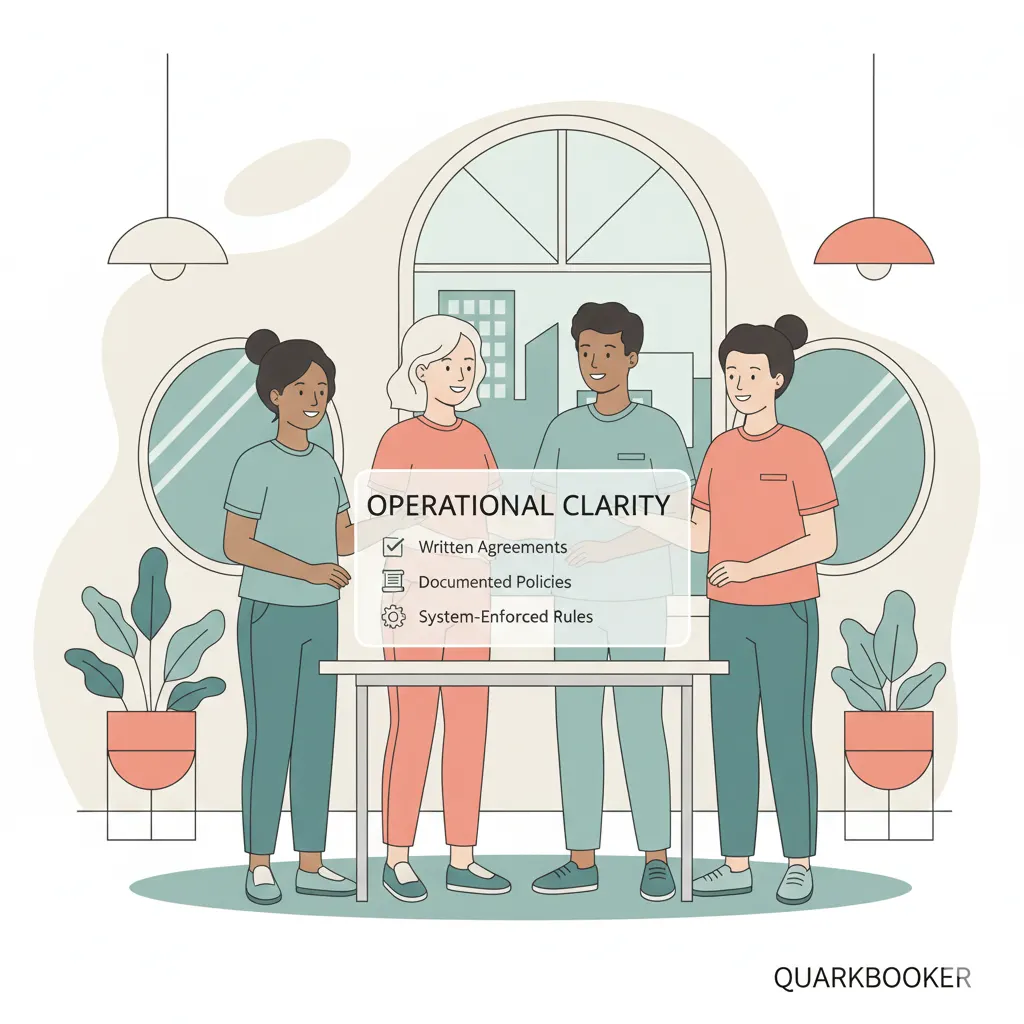
Professional salons understand that retention isn't built through motivational speeches or perks; it is built through operational clarity.
1. Turnover is a System Signal, Not a Personality Conflict
When multiple employees leave in a short window, the pattern matters more than the people. Common internal triggers include rule inconsistency, schedule instability, and commission confusion.
Workplace research from Gallup consistently shows that unclear expectations are a top predictor of employee disengagement. In a salon, where work depends on timing and fairness, "winging it" is a recipe for talent loss.
2. The Danger of "Verbal" Management
Many salons still manage staff through memory: “Don’t worry, we’ll adjust it later,” or “You know how we usually do it.” While the intention is flexibility, the result is uncertainty. Unwritten rules feel different to each person, making enforcement feel personal rather than professional. To fix this, high-growth salons replace verbal "understandings" with documented policies.
Deep Dive: Read our guide on why professional salons avoid verbal staff agreements to protect your culture.
According to employer best practices from SHRM, documented policies significantly reduce workplace disputes because standards are visible and repeatable.
3. Solving the Chaos of Scheduling
One of the fastest ways to repel talent is scheduling disorder. It’s rarely a single dramatic event; it’s the constant drip of late changes, overruns, and double bookings.
Research from the MIT Sloan Management Review shows that unpredictable scheduling is a primary driver of burnout. Top-tier salons stabilize this by using structured booking infrastructure where service durations are fixed and staff load is visible to everyone.
4. Compensation Clarity Over "Negotiation Stress"
Even when the total pay is competitive, uncertainty about how that pay is calculated creates an "exit trigger." Retention drops when commission rules shift or discounts affect a stylist's paycheck unpredictably.
Harvard Business Review highlights that perceived fairness—more than absolute pay—drives retention in skilled service roles. Professional salons maintain trust by documenting:
- Clear commission tiers
- Specific bonus conditions
- Transparent adjustment rules
5. Moving Beyond Owner-Centered Control
In a salon's early stages, owner intervention is natural. But as you grow, having staff constantly ask the owner for rule interpretations or pricing exceptions creates operational drag.
High-maturity salons shift from owner-enforced rules to system-enforced rules. You can see how luxury brands move beyond basic tools and manual control to scale their culture without the owner needing to be in the room 24/7.
The Operational Fix
Reducing turnover isn't about becoming stricter; it's about becoming clearer. To move from reactive management to a structured, professional environment, focus on:
- Written Staff Agreements
- Documented Salon Policies
- Structured Booking Systems
- Transparent Compensation Logic
If you are ready to build a disciplined, motivated team through systems rather than supervision, learn how top salons build high-performance teams or contact us today to see the QuarkBooker infrastructure in action.